Have you ever approved a fruit concentrate on price, then discovered the Brix, pack size, or storage needs do not fit production? It happens. An organic juice concentrate may look straightforward on a product sheet, yet one order can affect formulation, labeling, freight, warehouse space, and batch consistency.
Choosing a bulk juice concentrate supplier takes the same care. Price counts, but buyers also need to check paperwork, availability, and supply terms. A few early questions can prevent expensive production changes.
What Buyers Should Look for in an Organic Fruit Juice Concentrate Supplier
Buyers should look past fruit name and unit price. A supplier should be able to discuss specifications, origin, pack formats, lead times, storage, order size, and documentation without passing the buyer through several departments. Those details decide whether the ingredient fits the formula.
Organic Juice Concentrate Certification and Ingredient Traceability
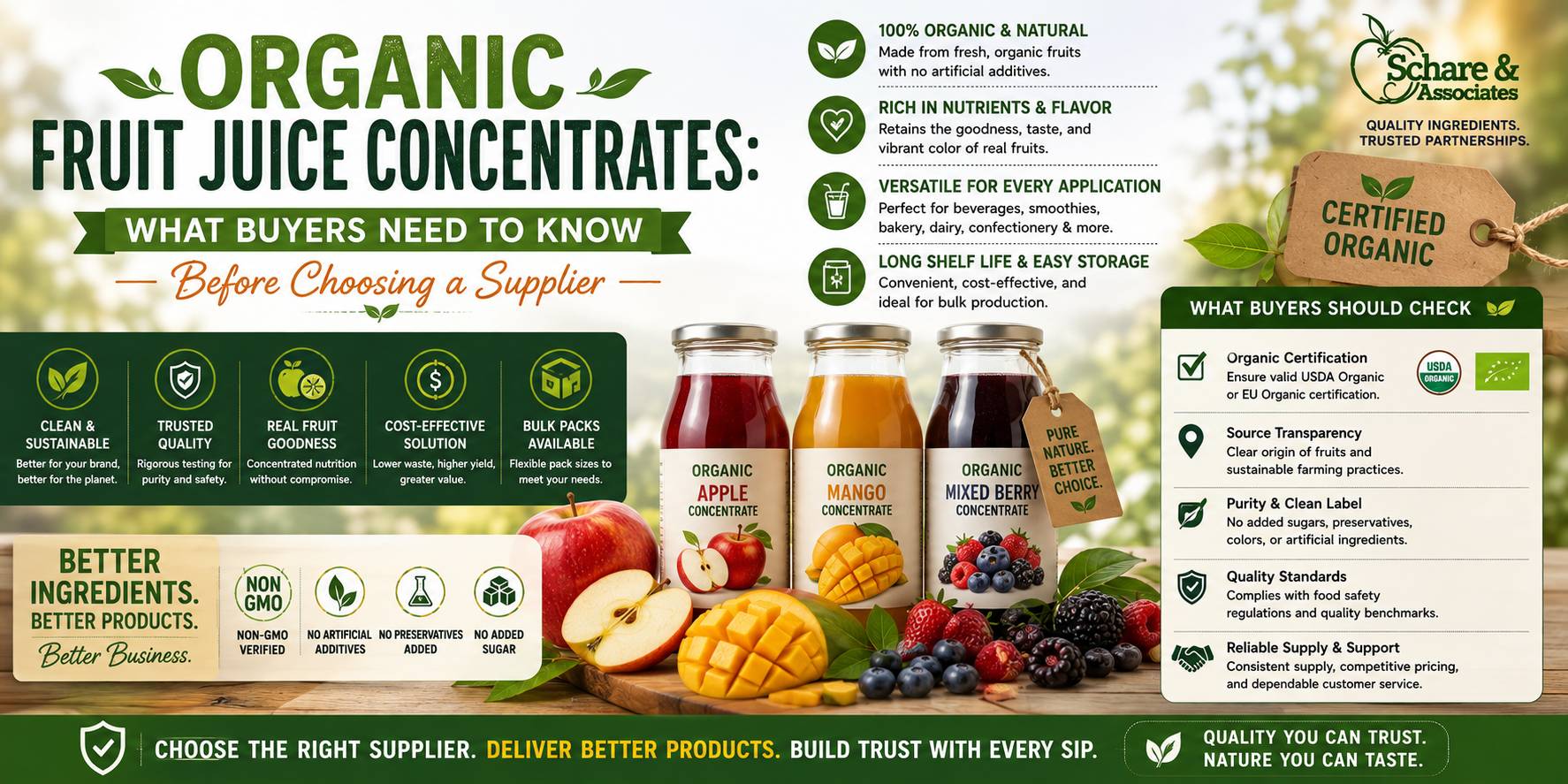
For an organic juice concentrate, certification is not just a line on a specification sheet. Buyers need to know which certification applies, who issued it, and whether the lot paperwork supports the claim used on the finished product.
Traceability needs equal attention. Ask for lot identification, origin, processing information, and supporting records before delivery. Quality teams may need these for audits or label review. Late paperwork can hold production even when the ingredient meets the formula.
Fruit Variety and Concentrate Specifications
Two concentrates made from the same fruit can perform differently. Brix may vary. So can acidity, color, aroma, pulp level, and flavor strength. Origin and processing method can change the result too.
A bulk juice concentrate supplier should explain those differences rather than treat every apple, grape, berry, or citrus concentrate as interchangeable. Match the specification to the end use. Beverage, bakery, dairy, sauce, and confectionery formulas can each need a different profile.
Consistency in Brix, Flavor, Color, and Quality
Brix gives buyers a starting point, but it should not be the only quality check. Flavor, aroma, color, acidity, and batch variation all affect performance after dilution or blending.
Processing can change composition as well. In research on juice cryoconcentration, antioxidant activity rose by 168%, 272%, and 343% across successive concentration stages. The result shows why buyers should ask how the ingredient was processed.
An organic juice concentrate should arrive with specifications technical teams can compare against the approved formula before production.
Packaging, Storage, and Shelf-Life Requirements
Pack format affects thawing, batching, freight, sanitation, and product loss. The wrong format can still create plant-floor problems.
|
Buying point |
What to check |
Production impact |
|
Pack size |
Pail, case, drum, tote, or other format |
Changes handling and batching |
|
Storage |
Frozen, refrigerated, or ambient |
Determines warehouse needs |
|
Shelf life |
Opened and unopened limits |
Affects inventory rotation |
|
Preparation |
Thawing, mixing, or dilution |
Changes production timing |
The useful pack size is the one that works with both the formula and the plant.
Order Quantities and Supply Flexibility
Not every buyer needs a truckload on day one. Trials, seasonal runs, and new formulas often begin with smaller volumes.
A bulk juice concentrate supplier that handles smaller and larger quantities gives purchasing teams more room. At JuiceDeals, we can work with quantities from individual pails or cases to multiple truckloads, which can suit development work and established production.
Research on the same cryoconcentration process also reported an approximately 429% increase in polyphenols in the third-stage concentrate compared with the starting juice. Processing details belong beside volume and price during review.
Sourcing Support for Hard-to-Find Fruit Concentrates
Some ingredients are easy to buy until a crop changes, an origin tightens, or a customer requests a narrow specification.
A wider supplier network can help when the usual source disappears. For an organic juice concentrate, that may mean another origin, pack size, fruit type, or related ingredient that still suits the formula. We also help buyers look for concentrates, purees, NFC juices, flavors, and other ingredients when the normal route falls short.
How a Bulk Juice Concentrate Supplier Can Simplify Purchasing and Product Development
Buying is not a simple process. Flavors may be modified during product development, storage, and quality review documents.
A bulk juice concentrate supplier can also decrease individual discussions when one of the juice suppliers can cover juice concentrate options, ingredients, order amounts, and availability.
Buyers can address multiple sourcing challenges in one link by sourcing from the same vendors for concentrate, puree, and flavor support. Fewer handoffs can also be used to cut development delays.
Why Choose JuiceDeals for Organic Juice Concentrate Sourcing
JuiceDeals operates through Schare & Associates, a business rooted in fruit concentrates and food ingredients. Keith Schare entered the fruit concentrate field in 1992 and formed Schare & Associates in 1997. That history covers decades of crop changes, sourcing shifts, and buyer requirements.
The organic selection includes apple, blueberry, cherry, cranberry, elderberry, grape, citrus, pear, pineapple, pomegranate, raspberry, strawberry, and several other fruit options.
Buyers can also access:
- Order sizes from individual cases or pails through truckload quantities.
- Help locating harder-to-source concentrates, purees, NFC juices, frozen fruit, flavors, and related ingredients.
We also work with an affiliated flavor house for flavors, juice bases, WONFs, and product matching. That support can be useful when a buyer is sourcing ingredients while adjusting a formula, testing substitutions, or planning a larger production run. It keeps sourcing conversations tied to what the finished product actually needs from trial through repeat production for changing commercial production needs.
Questions Buyers Should Ask Before Placing a Bulk Concentrate Order
Before ordering, ask for the specification, origin, certification status, storage condition, shelf life, lead time, and pack format. Compare them with production needs.
For organic products, confirm what documentation travels with the shipment and whether it supports labeling requirements. Ask what happens if origin or crop availability changes.
A bulk juice concentrate supplier should also explain minimum quantities, recurring volume options, freight considerations, and possible substitutes. Those answers show whether the supplier can support one purchase or an ongoing production program.
Conclusion
A good supplier choice comes down to fit. The ingredient, paperwork, and order size all have to work for the plant. The right organic juice concentrate should meet those needs without forcing changes elsewhere. A dependable bulk juice concentrate supplier should also help when availability, origin, or production plans change. If your team is comparing fruit concentrate options, contact JuiceDeals with the fruit, specification, volume, and end use needed, and we can help source the right product and place an order.
Frequently Asked Questions
Can fruit juice concentrate be used in clean-label products?
Yes, depending on the formulation, ingredient statement, processing method, and finished-product claims.
Is fruit juice concentrate the same as fruit puree concentrate?
No. Pulp and texture are generally maintained in puree concentrate, which is not the case with juice concentrate.
What should be listed on a concentrate specification sheet?
The usual attributes buyers inspect are the Brix, acidity, color, microbiological limits, storage, shelf life, origin, and pack details.
Are there any other products that can use concentrate?
Yes. Manufacturers use fruit concentrates in bakery, dairy, sauces, confectionery, snacks, and nutritional products.
How far ahead should buyers order fruit concentrate?
Lead times vary by fruit, origin, crop availability, pack format, and quantity, so buyers should confirm timing before production planning.