Does your next organic drink, yogurt line, or fruit filling depend on an ingredient that tastes right and protects your cost sheet? Buyers keep choosing fruit juice concentrates because they bring fruit flavor, sweetness, color, and acidity without the water weight of single-strength juice.
Organic buying is not casual. One late shipment can disturb a full run. Smart buyers study origin, Brix, acidity, certification, storage format, and lead time before comparing prices. US buyers have a tougher job now. Retailers want cleaner labels. Production teams still need steady material, repeatable taste, and workable margins.
Organic concentrates fit that space. Less water means lower storage pressure, lighter freight, and more control. For juices, smoothies, sauces, bakery fillings, dairy products, frozen desserts, and cocktail bases, this format keeps planning less messy.
Fruit bases behave differently, so buyers must treat each one as a technical input, not a commodity.
Market Overview: Pricing Trends and Supply Factors in Organic Juice Concentrates
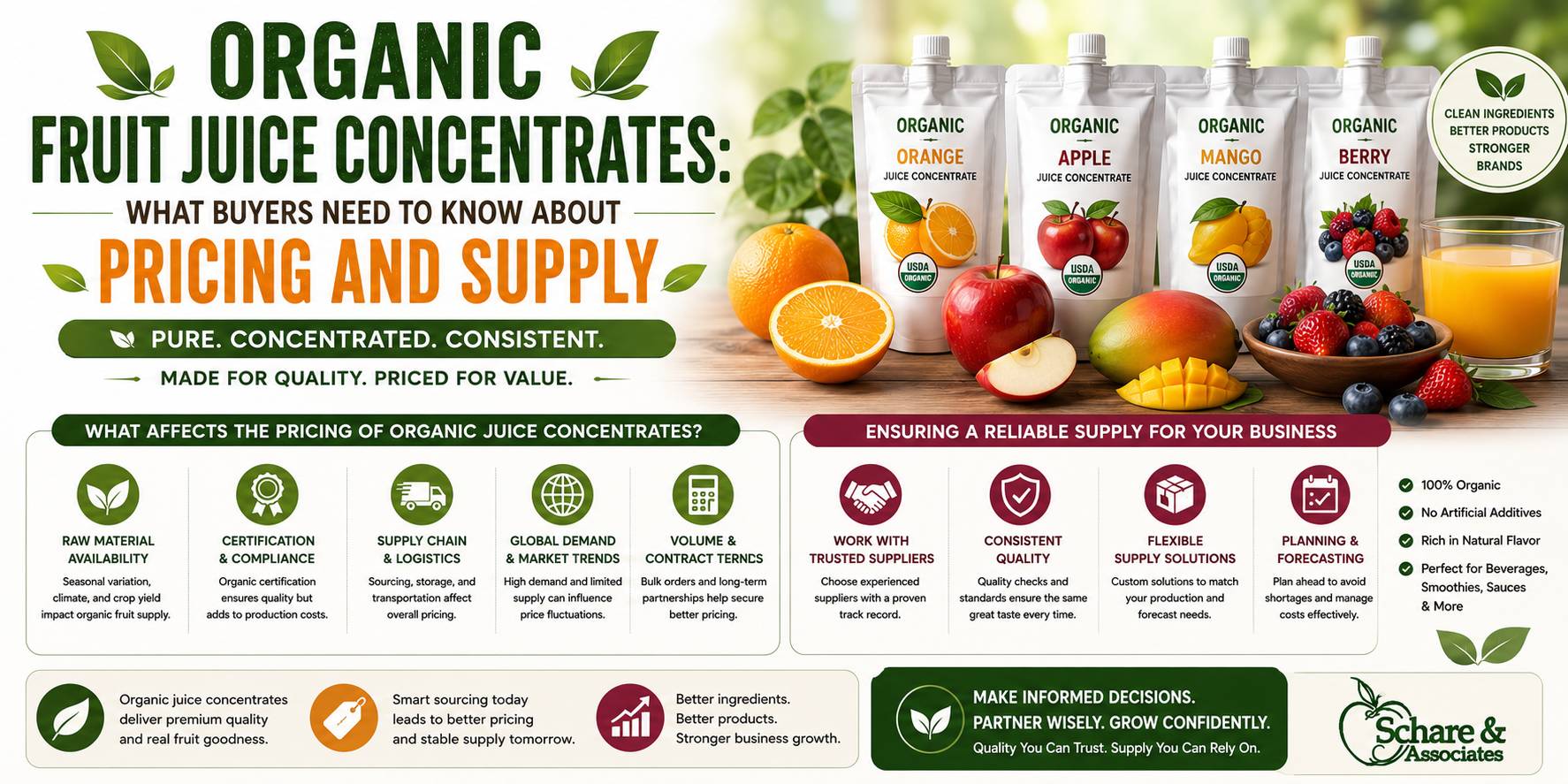
Pricing in organic concentrates starts in the field. Weather, crop yield, fruit variety, farm labor, organic certification, and processing loss affect the quote before freight enters. Buyers must then add packaging, cold chain needs, and warehouse costs.
Many teams compare two numbers on a supplier sheet and call the lower one better. That may work for office supplies, not fruit ingredients.
Research shows that properly processed 100% juice concentrates can keep meaningful levels of vitamin C, potassium, and other micronutrients after water removal and reconstitution. So the buying discussion needs price, taste, nutrition, and plant behavior.
How Organic Fruit Juice Concentrates Add Value for Buyers
For buyers, value is not only about getting a lower quote. It is about choosing an ingredient that supports taste, storage, production speed, and supply planning. Organic concentrates help teams work with fruit flavor in a more controlled way while keeping waste, freight pressure, and last-minute buying stress lower.
Stable Quality Across Batches for Production Use
A production manager wants the March batch to taste like the June batch. Fruit juice concentrates support that goal because processors can standardize Brix, color, acidity, pulp level, and flavor profile. Buyers should still request samples and specs. A good spec gives production a target and helps procurement judge replacements.
Extended Shelf Life That Reduces Product Loss
Fresh juice gives buyers a short clock. Organic fresh fruit can move even faster because availability changes with season and region. Concentrated formats stretch that timeline. For buyers, that means less panic purchasing and better rotation planning. Frozen drums, aseptic packs, and totes need different handling, so warehouses should review storage limits before purchase.
Versatile Use in Beverages, Dairy, and Bakery
One reason buyers like fruit juice concentrates is their range. Beverage teams use them in juice drinks, sparkling beverages, teas, smoothies, and functional products. Bakery teams use organic apple or berry concentrate in fillings, toppings, and fruit prep. Dairy teams use fruit bases in yogurt, kefir, ice cream, and dessert cups. Still, no buyer should assume one concentrate works everywhere.
Clean Label Appeal Driving Consumer Demand
Organic shoppers often read the back panel first. They notice fruit-derived ingredients, organic claims, and familiar names. A concentrate can keep the ingredient panel close to what the customer expects when the formula needs fruit sweetness or color.
A single 240 ml, or 8 oz, serving of reconstituted orange juice from concentrate can provide 100% of the Daily Value of vitamin C. Buyers should still ask how the ingredient performs after processing.
Easier Bulk Storage and Inventory Handling
Storage cost rarely gets enough attention in early buying talks. A low ingredient price can lose appeal when a plant has no freezer space or room for drums. Concentrates reduce volume compared with single-strength juices, so they often help bulk storage planning. Buyers still need to check pack size, weight, temperature range, shelf life, thawing time, and minimum order quantity.
Better Planning With Predictable Supply Cycles
Organic crops follow the farm, not the buyer’s launch calendar. A storm, poor yield, transport delay, or sudden demand spike can change availability fast. Buyers who plan early usually get better choices in origin, format, and price window. When sales forecasts line up with purchase timing, the company can carry enough material without trapping too much cash in inventory.
Choosing JuiceDeals for Organic Fruit Juice Concentrate Needs
JuiceDeals connects with this category because its work centers on bulk fruit ingredients for food and beverage manufacturers. The range includes concentrates,purees, NFC juices, frozen fruits,essences, natural flavors, tomato products, and organic options. It is built for commercial use, not retail shopping.
For buyers, the useful part is the width of supply. A beverage brand may need orange concentrate now and mango puree next month. A bakery company may need berry ingredients, apple concentrate, and natural flavor support. We look at the application, pack format, availability, and documentation before matching options.
Practical buyer advantages include:
- Bulk quantities suited for manufacturing plants and contract production
- A broader fruit ingredient range that can reduce supplier chasing
- Global sourcing access for seasonal and year-round needs
We do not treat sourcing as a one-item sale. The aim is to help buyers narrow choices before cost and supply risk turn into production problems.
Supply Chain and Pricing Insights for Smart Buying
Organic concentrate buying gets better when procurement works with R&D, quality, logistics, and finance. R&D sees flavor. Quality sees documents. Logistics sees storage. Finance sees landed cost and cash timing.
That is why fruit juice concentrates should be compared through total use cost, not just quote price. A higher Brix product may cost more per pound but less per finished gallon. A frozen format may price well but strain warehouse space. A higher quote with cleaner paperwork and steadier lead time may protect the launch better.
|
Buying Factor |
What to Check |
Why It Changes Cost |
|
Brix and acidity |
Concentration, dilution ratio |
Usage rate and taste |
|
Certification |
Organic proof, origin, traceability |
Label claims |
|
Format |
Frozen, aseptic, drum, tote |
Handling and storage |
|
Lead time |
Processing slot, freight window |
Spot buying risk |
|
Application fit |
Heat, pH, color, texture |
Reformulation waste |
Before ordering, buyers should request a spec sheet, sample, allergen statement, origin, shelf-life data, storage instructions, and organic certificate. If the product supports a label claim, quality should review it before packaging goes to print.
Conclusion
Organic concentrate buying rewards buyers who slow down at the right stage. The quote counts, but the full decision includes Brix, yield, origin, certification, storage, application fit, and delivery timing. A strong purchase supports taste, label goals, production flow, and margin. When a buyer wants a steady fruit ingredient, fruit juice concentrates can make the supply plan stronger. For organic ingredient needs, order with a team that knows how we source, compare, and support bulk fruit materials.
FAQs
How early should buyers book organic concentrate supply?
Start before peak season for crop-sensitive fruits.
Can organic concentrate replace fresh fruit in every formula?
No. Texture, pulp needs, and fresh fruit identity may require another format.
What does Brix mean when buying organic concentrates?
Brix shows soluble solids. It helps estimate concentration, dilution, and usage cost.
Why do organic concentrate prices change so often?
Prices move with harvest size, weather, yield, certification cost, freight, storage demand, and buyer activity.
What should a buyer test before scaling an order?
Test flavor, acidity, color, Brix, heat response, packaging fit, and stability.