
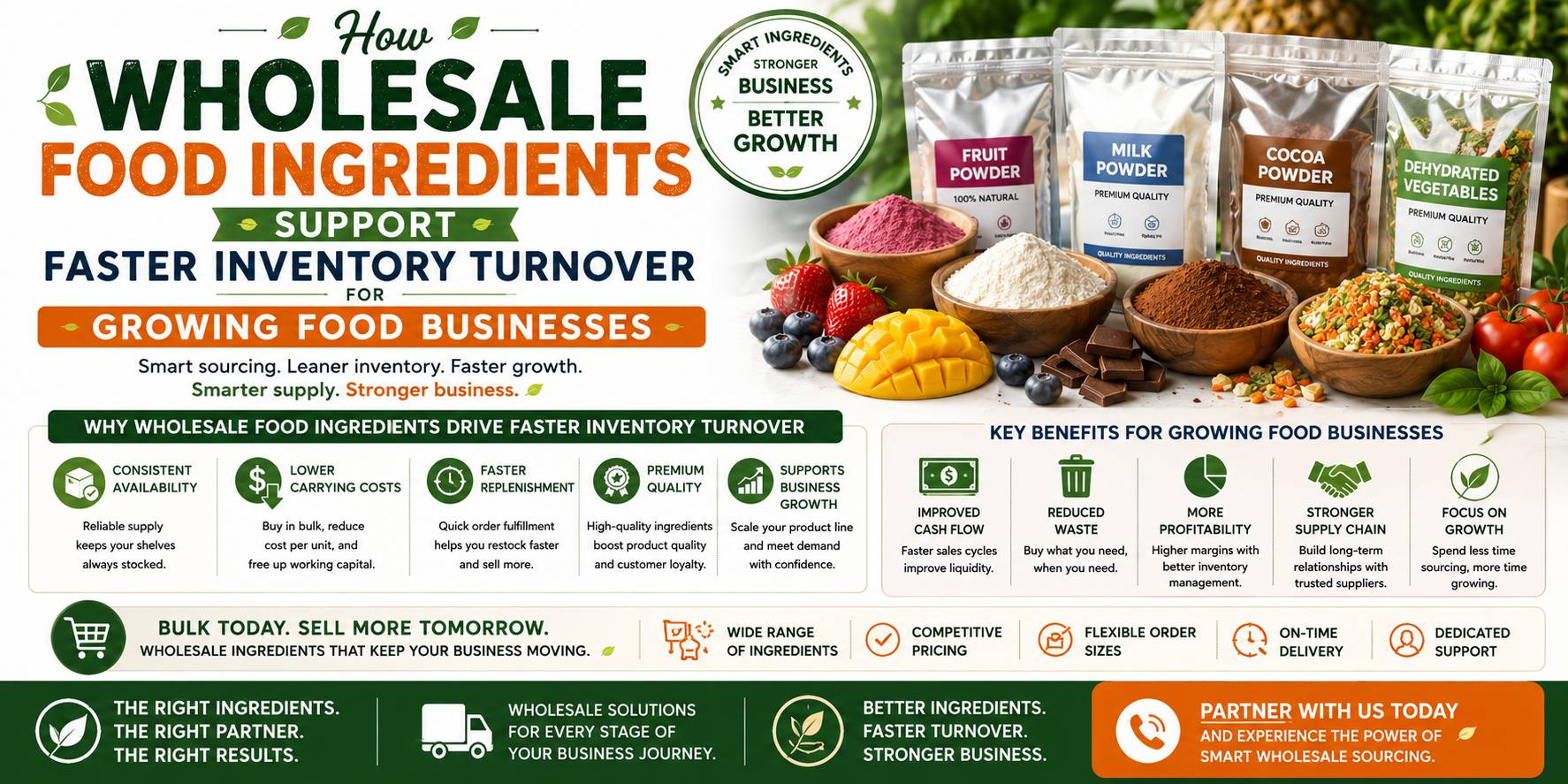
Are raw materials lingering in storage while finished products move out the door? That gap hurts food companies. Slow inventory turnover ties up cash, crowds storage, and forces teams to buy around old stock for months instead of buying for demand. For a business adding new accounts, inventory speed becomes a business issue. Wholesale food ingredients help solve that problem because they give buyers more control over timing, pack size, cost, and availability.
A beverage brand that keeps orange concentrate, sweeteners, and natural flavors moving on schedule can produce, ship, invoice, and reorder without the stop-start pattern that drains margin. Fast turnover comes from sharper purchasing, cleaner forecasting, and supplier choices that fit production volume.
How Wholesale Food Ingredients Drive Faster Inventory Turnover
Inventory turnover improves when purchasing lines up with how a plant, kitchen, or co-packer actually runs. Buyers who treat every ingredient the same usually end up with gaps or leftovers.
Bulk Purchasing Reduces Frequent Stock Gaps
Planned bulk purchasing removes waste from the buying cycle. A sauce manufacturer that uses the same fruit puree in three SKUs should not place small emergency orders every week. Buying wholesale food ingredients in planned volumes reduces rush freight, lowers the risk of partial shipments, and helps production managers lock in runs with fewer surprises.
Buy against real sales history. If a company moves 1,200 cases a month, the ingredient order should reflect that pace plus a small buffer.
Consistent Supply Helps Maintain Daily Sales Flow
Daily sales need daily production. If one item goes missing, the finished goods stall. A smoothie producer may have cups, labels, labor, and customer orders ready, yet one delayed mango puree can push the line off schedule. That is common in food operations that rely on scattered sourcing.
The World Health Organization reports that several thousand food additives are used across food production worldwide, covering preservation, coloring, flavor enhancement, stabilization, and texture functions. That range shows how one missing input can hold up far more than one formula.
Lower Per-Unit Cost Allows Faster Pricing Decisions
Food businesses price faster when procurement has a dependable landed cost. Sales teams do not want to wait days for a quote because buyers are still chasing freight. When companies buy wholesale food ingredients at a better unit cost, they can move more quickly on distributor pricing, private label bids, and seasonal offers. A snack producer looking at diced dried mango can commit to a case price early when the cost stays stable.
Flexible Packaging Sizes Fit Different Menu Needs
Pack size changes the buying equation. A regional beverage company may need drums for a production run next month, while a smaller brand may need pails for pilot batches and retail tests. The wrong format creates drag. Teams open too many containers, store half-used product, or overorder just to hit a supplier minimum.
That is one place where we help clients avoid waste. JuiceDeals works with businesses that need ingredient formats matched to production reality, whether that means frozen fruit in bulk, juice concentrates for processing, or smaller workable lots during a launch.
Easier Demand Planning With Standardized Ingredients
Standardized ingredients make planning easier. Buyers can compare usage by lot, pack size, yield, and finished case output without cleaning up five versions of the same item in the purchasing file. A planner can link one pallet of strawberry puree to a known number of finished bottles, then set reorder points with more accuracy.
FDA rules require food manufacturers to declare ingredients on food labels unless an exemption applies. That pushes traceability and documentation much higher on the purchasing checklist. If the allergen statement, spec sheet, or lot record arrives late, production can slow even when the product itself is already in the building.
Reduced Lead Time Keeps Shelves And Kitchens Active
Lead time drives inventory behavior more than most operators admit. Long delays push companies to carry extra stock, and that ties up cash and warehouse space. Shorter lead times let teams buy closer to actual need. Companies sourcing wholesale food ingredients through responsive suppliers can react faster when demand jumps, when a customer adds a rush order, or when a regular supplier comes up short.
A bakery that finds raisins quickly through an active surplus channel can protect weekend output instead of leaving ovens idle.
How Juice Deals Supports Efficient Ingredient Sourcing For Growing Brands
JuiceDeals serves buyers across the food and beverage supply chain, from beverage manufacturers and co-packers to wineries, breweries, distributors, food brokers, and pet food producers. The catalog covers frozen fruits, fruit purees, juice concentrates, dried fruits, nuts,sweeteners, natural flavors, food chemicals, vegetable products,coffee, tea, and organic ingredients.
For buyers needing hard-to-find items, larger volumes, or quick access to inventory, we offer our Hot Deals. Companies with surplus stock no longer need to let their product age in storage and can recover its value.
Our key strengths include:
- More than 25 years in sourcing and redistributing ingredients.
- Broad category coverage and surplus liquidation with repeat buying.
What To Look For When Selecting Food Ingredient Suppliers
Finding the right supply source for a food business is more than just cost. They must consider the supply that protects turnover, paperwork, and the flow of production.
|
Factor |
What To Check |
Why It Affects Turnover |
|
Category coverage |
Core products, substitutes, available formats |
Fewer sourcing delays |
|
Documentation |
Specs, allergen records, certificates, lot details |
Faster approval and release |
|
Shelf life |
Remaining life, storage history, handling conditions |
Lower spoilage risk |
|
Lead time |
Stock location, freight options, order cutoffs |
Better planning for production |
Suppliers also know how products behave after arrival. Frozen fruit carries different storage pressure than dried ingredients. Sweeteners move differently from natural colors.
Conclusion
Growing food businesses do not improve inventory turnover by buying less. They improve it by buying with more precision, tracking shelf life, and working with suppliers who can deliver stock with the right paperwork and timing. Wholesale food ingredients provide the quickest sales cycle when the sourcing plan is in harmony with production, demand, and the capacity of storage.
JuiceDeals provides smarter sourcing, greater value recovery on surplus inventory, and low-cost supply alternatives. Reach out to us to place an order or source an ingredient, and sell stock that’s surplus and cutting into your profits.
FAQs
What Causes Slow Ingredient Turnover In Food Businesses?
Overbuying, poor forecasting, weak SKU planning, and long supplier lead times cause most slow-turn problems.
How Often Should Buyers Review Ingredient Usage?
Monthly works for many companies, but high-volume plants often review items every week.
Do Surplus Ingredients Have The Potential To Be Useful For Production?
Definitely, provided the buyer ensures that shelf life and packaging are acceptable, and they check specs and the storage information.
What Does A Buyer Need To See To Complete Their Purchase?
The storage information and a spec sheet, as well as the statement of allergens, and a certificate of analysis with lot information.
Why Does Inventory Turnover Become An Issue With Improper Pack Sizes?
Improper pack sizes lead to surplus, additional handling, and slower turnover of inventory in production.