
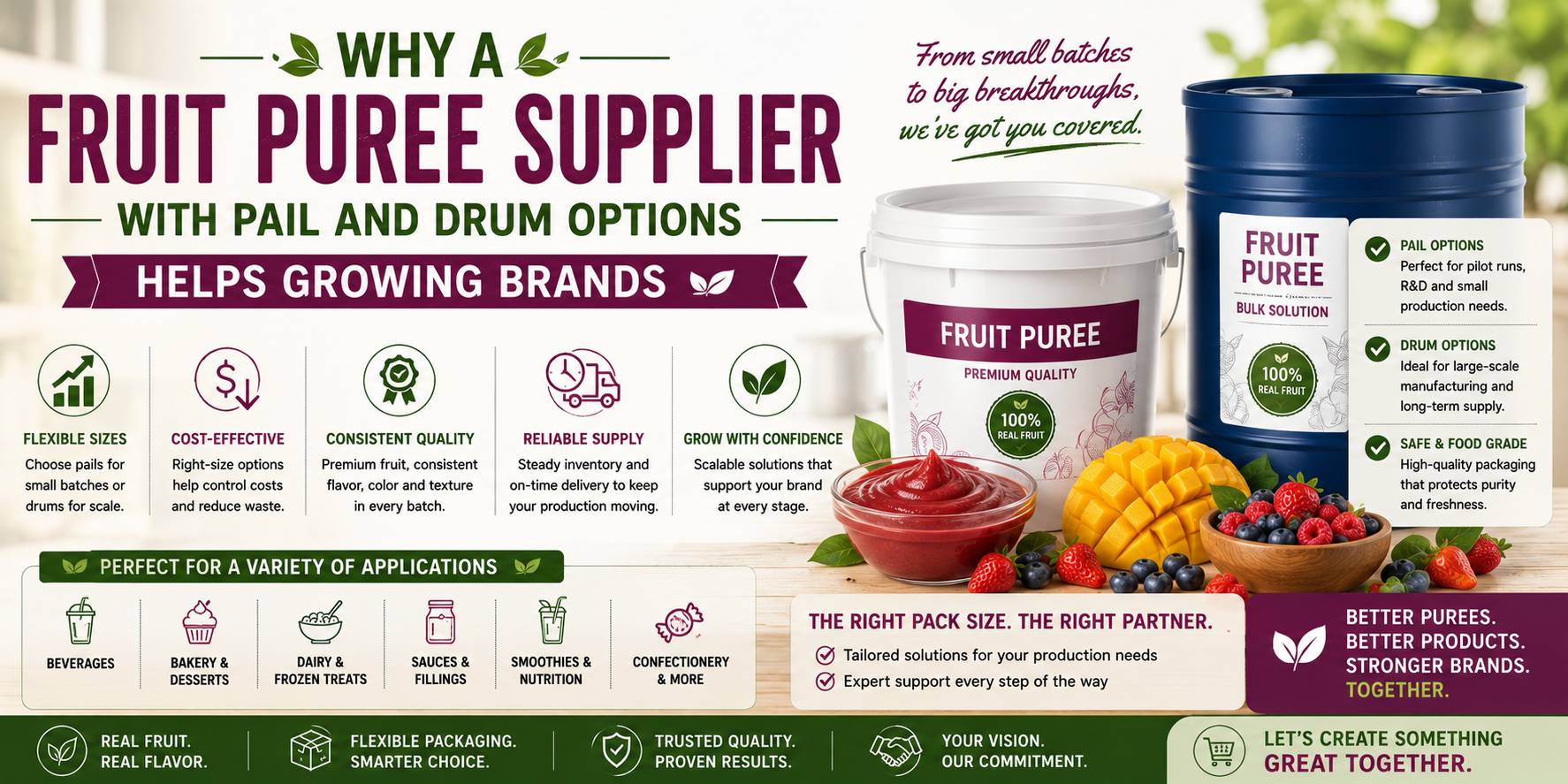
What happens when a product that began as a small test suddenly needs twice the fruit input next month? You may start with a few pails, then need drums once repeat orders become steady. A fruit puree supplier that offers both formats gives your purchasing team room to move without changing sources each time production changes.
Packaging reaches further than storage. It affects receiving, warehouse space, handling, and cash tied up in stock. For a growing US food brand, the wrong pack size can turn into excess stock or a last-minute shortage.
How Bulk Fruit Puree Packaging Supports Brands at Different Growth Stages
Production rarely climbs in a straight line. A beverage may jump after a retail placement. A bakery may need raspberry every week but passion fruit only for summer. Pails and drums let purchasing follow those shifts.
Lower-Volume Pails for Product Trials and Limited Production Runs
Pails work well while a formula is still changing. R&D teams adjust sweetness, acidity, texture, and fruit percentages before a recipe settles. Buying a drum too soon can leave product behind if the formula changes.
That is why brands often start wholesale fruit puree in smaller quantities. A fruit puree supplier with pail options lets teams trial mango, guava, peach, berry, or tropical flavors without committing to more stock than the launch needs.
Drum Packaging for Larger and More Frequent Manufacturing Needs
Drums become a better fit once production repeats at higher volume. The plant receives fewer containers, and operators open fewer units.
Mango puree research found all-trans beta-carotene retention at about 65% to 72%, depending on the processing method. It points to a wider purchasing issue. Buyers should compare processing history, storage, specifications, and intended use instead of judging puree by fruit name and price alone.
Easier Inventory Planning Without Ordering More Than Production Requires
A large pack is not efficient if part of it remains unused. A small pack is not efficient if the plant keeps placing emergency orders.
|
Production need |
Better-fit format |
Purchasing advantage |
|
Formula testing |
Pails |
Smaller commitment |
|
Seasonal production |
Pails |
Tighter quantity control |
|
Repeat mid-volume runs |
Pails or drums |
More room to adjust |
|
High-volume output |
Drums |
Fewer containers |
|
Several fruit SKUs |
Mixed formats |
Orders follow usage |
For a team searching for a bulk fruit puree supplier USA option, mixed formats can solve an awkward problem. One fast seller may need drums while slower flavors stay in pails.
Fewer Ingredient Handling Steps for Busy Production Teams
Every container creates work. Staff receive it, move it, store it, open it, and later remove the empty packaging.
Growing plants often move only their core flavors into drums. Slower products stay in pails. We look at how quickly each ingredient moves rather than assuming every growing customer should buy the largest format available. That usually keeps stock closer to plant use.
Better Flexibility When Seasonal Demand or Order Volumes Change
Weather, retail promotions, holidays, menu cycles, and customer contracts can move demand fast. A fruit line that runs hard in June may barely move in January.
Processing also changes what arrives at the plant. One durian puree study recorded ascorbic acid retention of 81% with HPP and 82% with CO2 plus HPP, compared with 69% after thermal processing. Those numbers do not apply to every puree. They still show why technical specifications belong beside pack size during purchasing.
Smoother Scaling From Small Batches to High-Volume Production
Brands usually scale in steps. A team may start with a few pails, move into repeat pail orders, then shift one successful SKU into drums. Another flavor may stay small for years.
A fruit puree supplier with both formats can support those different paths without making the buyer rebuild sourcing each time volume changes. For businesses purchasing wholesale fruit puree, that continuity can also make approvals and purchasing records easier to manage as new SKUs arrive.
How Juice Deals Works as a Fruit Puree Supplier for Flexible Supply Needs
Juice Deals works with commercial buyers that do not all purchase at the same scale. We can support an order that starts with a single pail and, as the program grows, moves into drums or much larger quantities. Food manufacturers, beverage companies, co-packers, breweries, and wineries can match purchases more closely with production.
The range includes mango, strawberry, apple, peach, and raspberry, plus less common options such as acerola, acai, dragon fruit, cupuacu, maqui, and mangosteen.
A few points stand out:
- more than 25 years of fruit-industry experience
- access to purees, concentrates, frozen fruit, flavors, and other fruit ingredients
- help locating harder-to-source fruit products
- order flexibility for trials, seasonal runs, and repeat production
We also work with affiliated flavor and formulation capabilities when beverage teams need support beyond ingredient sourcing.
Where Pail and Drum Fruit Purees Fit Across Food and Beverage Production
Puree appears in far more products than smoothies. Beverage teams use it in juices, cocktail bases, mocktails, and specialty drinks. Bakeries use it in fillings and toppings. Manufacturers add it to sauces, glazes, dairy products, frozen desserts, marinades, and prepared foods.
Pack size should follow the speed of use. A bakery rotating six fruit fillings may prefer pails because each flavor moves differently. A co-packer producing the same beverage every week may prefer drums because the ingredient turns over faster.
The same purchasing plan can cover concentrates, flavors, and other fruit ingredients. Teams can line up those inputs with batch dates instead of placing disconnected orders. A supplier becomes more useful when packaging fits the actual production mix.
Conclusion
Pails and drums solve different jobs. Pails suit early testing, seasonal lines, and lower-volume flavors. Drums suit ingredients that move through production often enough to justify the larger format. Neither option wins in every plant.
The right fruit puree supplier should help buyers match fruit, packaging, and volume to production needs. If your team is reviewing puree sourcing or preparing a new line, speak with Juice Deals about the fruits, pack sizes, and quantities you expect to use. We can help you order around the production schedule you already have.
FAQs
How long does fruit puree usually last after opening?
Shelf life depends on the fruit, processing method, packaging, and storage temperature. Commercial buyers should follow the opened-product instructions for the exact SKU.
What should a buyer check before approving a new fruit puree?
Review Brix, acidity, ingredients, origin, microbiological limits, storage conditions, shelf life, allergen information, and certificate-of-analysis requirements used by your quality team.
Can fruit puree be used in alcoholic beverages?
Yes. Breweries, wineries, distilleries, and cocktail producers use puree. Formulators still need to account for sugar, acidity, solids, fermentation behavior, and flavor intensity.
Is puree concentrate interchangeable with standard puree?
No. Concentrate has part of its water removed, so it carries more solids in less volume. A formulator must adjust water, sweetness, and usage rate before replacing standard puree.
Do all fruit purees have the same Brix level?
No. Brix varies by fruit, harvest, processing, and whether the product is standard puree or concentrate. Buyers should use the product specification for each SKU.